Back in 2007 and 2008, I had the great opportunity to evaluate the organizational project management maturity of today’s most recognized brand in the retail banking industry in Canada according to Interband.
It was the time when the top five banks expanded or consolidated their operations overseas in an effort to find new sources of revenue and to increase their presence in the global financial market. TD purchased the New Jersey based Commerce Bancorp; RBC completed the acquisition of RBTT Financial Group in Trinidad and Tobago and four wealth and investment firms in US; Scotiabank purchased several banks and related financial services across Latin America (Grupo Altas Cumbres, Banco del Trabajo, Banco de Antigua and ProFuturo AFP), and BMO bought Griffin, Kubik, Stephans, and Thompson based in Chicago.
The expansion seemed to be an indication that Canadian banks were prepared to take a risk and penetrate markets dominated by global giants as JPMorgan Chase Bank, Bank of America, Banco Santander, Wells Fargo Bank and Citibank.
However, does this mean they also achieved the project management maturity to manage the risks, challenges and opportunities of those markets?
Method and Results.
For the evaluation, I had selected the Organizational Project Management Maturity Model (OPM3) standard as this method offers the ability to measure the overall bank project management maturity against a comprehensive and broad-base set of organizational project management best practices. In comparison to the Capability Maturity Model Integration (CMMI) from the Software Engineer Institute that focuses on the evaluation of the processes for developing and maintaining products, services, software and systems.
Results indicated a solid mature set of capabilities in the project domain or the equivalent of CMMI level three for those not familiar with the OPM3 method, and a minimal existence of program or portfolio capabilities. Furthermore, when comparing the results of the assessment against others banks, similar tendencies were identified.
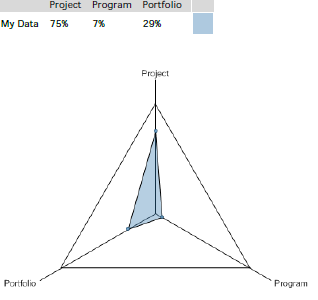
It is important to mention that RBC demonstrated having a solid enterprise program framework and tools, and BMO revealed the most robust and complete set of IT project management capabilities thanks to the adoption and implementation of CMMI back in 2000 and posterior achievement of CMMI level 4 in 2005.
Considering that these banks have a project portfolio configuration of around 90% to 93% stand-alone projects, the near absence of program management indicators maybe justifiable and may not represent a mayor risk to the integrity of the overall investment, because this is compensated by strong financial and risk management practices inherited from other financial operations within the organization.
Portfolio management as defined by the Project Management Institute in the Standard for Portfolio Management, is “the coordinated management of one or more portfolio to achieve organizational strategies and objectives, It included interrelated organizational processes by which an organization evaluates, selects, prioritizes, and allocates its limited internal resources to best accomplish organizational strategies”.
The UK Office of Government Commerce in their Management of Portfolios defined Portfolio Management as “a coordinated collection of strategic process and decision that enable the most effective balance of organizational change and business as usual. Ensuring that prioritized in line with strategic objectives and business priorities and in the context of the existing portfolio, affordability, risk, resource capacity and the ability to absorbed the change”
Base on the previous arguments, the absence of portfolio management capabilities does represent a major risk to the achievement of the Canadian bank’s strategy as fundamental questions, such as; do we have the resource capacity to execute the project portfolio in the timeframe needed to achieve the return of investment? Are we selecting the correct projects? And How we know the right prioritization is in place?, cannot be answered factually.
Future State
In this regard, the necessity to have accurate and better quantifiable objectives in order to maintain competiveness and reduce operational cost overall, will lead the top five banks to adopt and implement program and portfolio management capabilities as part of their enterprise project management framework.
Today there are strong signals that these changes are taking place. As example TD is implementing an Enterprise Portfolio Governance, RBC has Enterprise Project Portfolio Management roles, CIBC deployed an Enterprise Project and Portfolio Management tool and BMO has a Program and Project Management Centre of Excellence. This is excellent news as it demonstrates that Canadian banks are on the right track to deal with the challenges and opportunities that the international markets have to offer.
 Jimmy Pimentel